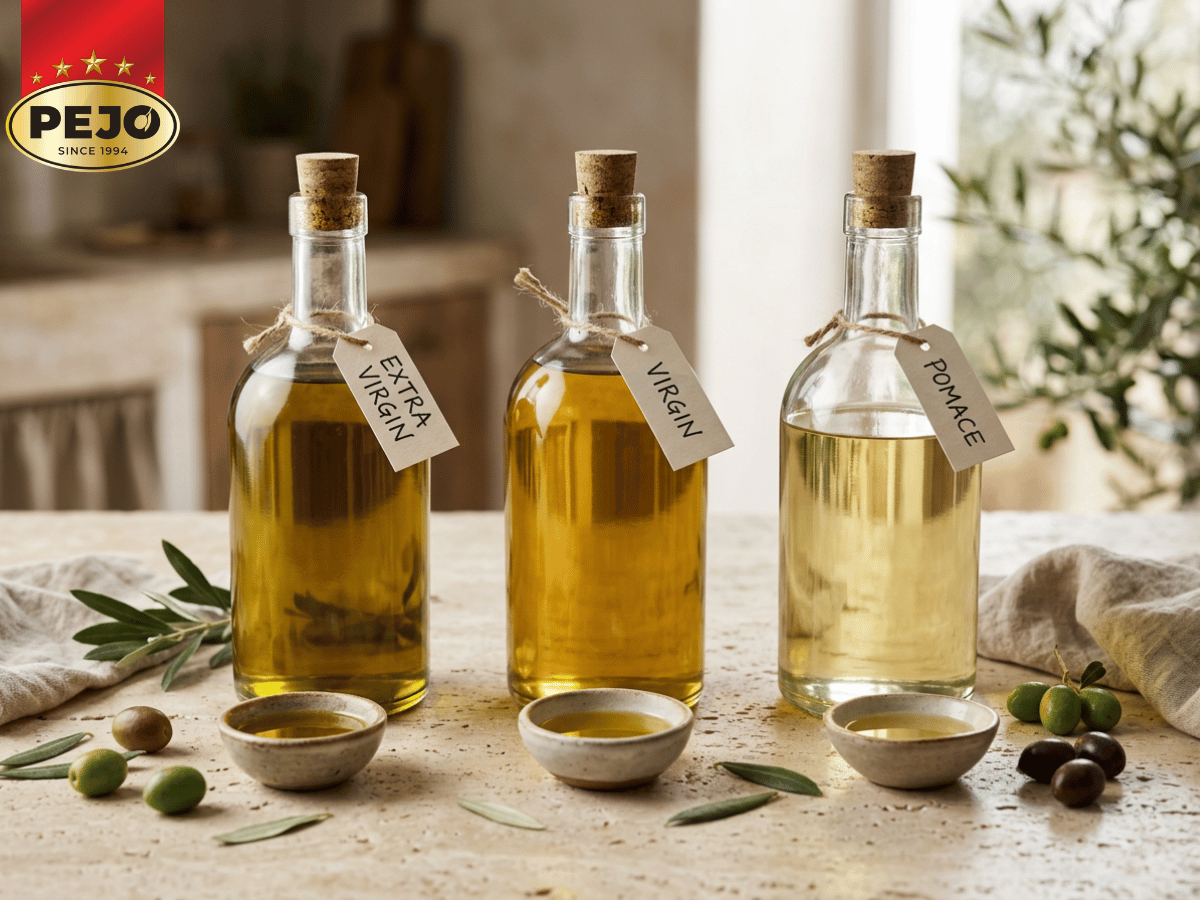
Not all olive oils are created the same way. Although extra virgin, virgin, and olive pomace oil all originate from olives, their production methods, quality classifications, flavor profiles, and culinary applications differ significantly.
If you’ve ever wondered about extra virgin vs virgin olive oil, or whether olive pomace oil is suitable for everyday cooking, understanding these distinctions can help you choose the right oil for your kitchen.
The main difference lies in how each oil is obtained and classified. Extra virgin and virgin olive oils are extracted directly from olives through mechanical processes, while olive pomace oil is produced from the material remaining after the initial extraction and undergoes additional processing.
In this guide, we’ll compare the three categories, explain their acidity standards, explore their nutritional characteristics, and identify the best uses for each.
Extra Virgin vs Virgin vs Pomace Olive Oil: Quick Comparison
The following table summarizes the main differences between these three olive oil categories.
| Feature | Extra Virgin Olive Oil | Virgin Olive Oil | Olive Pomace Oil |
|---|---|---|---|
| Production | Mechanical extraction | Mechanical extraction | Extraction from olive pomace, refining, and blending |
| Maximum free acidity | 0.8% | 2.0% | 1.0% |
| Flavor | Fruity, often peppery or bitter | Generally milder or less refined in sensory quality | Usually mild or relatively neutral |
| Refining | No | No | Yes |
| Sensory classification | Fruity, without sensory defects | Minor sensory defects permitted | Different classification standards |
| Natural phenolic compounds | Generally higher | Present in varying amounts | Generally lower after refining |
| Typical uses | Dressings, dipping, cooking, finishing | Everyday cooking, sauces, marinades | Frying, baking, food preparation |
| Typical price positioning | Premium | Mid-range | Economical |
Note: Acidity percentages refer to free fatty acidity, expressed as oleic acid, not the sourness of the oil. These limits follow internationally recognized classification standards.
For a detailed explanation of the classifications, see the European Commission’s official guide to olive oil.
What Is Extra Virgin Olive Oil?
Extra virgin olive oil (EVOO) is the highest recognized grade of virgin olive oil. It is obtained directly from olives using mechanical or other permitted physical processes, without chemical refining.
To qualify as extra virgin, the oil must satisfy strict chemical and sensory requirements.
Under European Union standards, extra virgin olive oil must have a free acidity level of no more than 0.8%. It must also demonstrate fruitiness and have no detectable sensory defects under the official assessment method.
How Is Extra Virgin Olive Oil Produced?
Production generally involves several important stages:
- Harvesting: Olives are collected and transported for processing.
- Cleaning and crushing: Leaves and foreign materials are removed before the olives are crushed into a paste.
- Malaxation: The paste is slowly mixed to help small oil droplets combine.
- Extraction: Oil is separated from the olive paste through mechanical processes, commonly centrifugation.
- Storage and packaging: Appropriate storage conditions help protect the oil from oxidation and quality deterioration.
The quality of the olives, processing conditions, and subsequent handling all influence the finished product.
What Does Extra Virgin Olive Oil Taste Like?
Extra virgin olive oil can display a wide range of flavors depending on olive variety, maturity, growing conditions, and processing.
Common characteristics include:
- Fresh, fruity aromas
- Green or ripe olive notes
- Herbal or grassy characteristics
- Pleasant bitterness
- A peppery sensation in the throat
Bitterness and pungency are not necessarily defects. In balanced extra virgin olive oils, they are often desirable sensory attributes associated with naturally occurring phenolic compounds.
Best Uses for Extra Virgin Olive Oil
Extra virgin olive oil is particularly suitable for dishes where its natural character can enhance the final result.
It works especially well with fresh salads, grilled vegetables, bread, Mediterranean appetizers, pasta, and finished dishes.
It is also suitable for many cooking methods, including sautéing and roasting.
Best choice: Extra virgin olive oil is an excellent option when flavor, minimal processing, and naturally occurring olive compounds are priorities.
What Is Virgin Olive Oil?
Virgin olive oil is also extracted directly from olives using mechanical or other permitted physical methods.
Like extra virgin olive oil, it does not undergo chemical refining.
However, the difference between virgin and extra virgin olive oil comes from the chemical and sensory requirements each category must meet.
Virgin olive oil permits a maximum free acidity of 2.0%, compared with 0.8% for extra virgin olive oil.
It may also contain minor sensory defects that would prevent it from qualifying as extra virgin.
Importantly, an oil can have acidity below 0.8% and still fail to qualify as extra virgin if it does not meet the remaining chemical or sensory requirements.
How Does Virgin Olive Oil Taste?
Virgin olive oil retains the natural character of olives, although its sensory profile can be less refined than that of a properly classified extra virgin oil.
Its flavor varies according to production conditions and the characteristics of the olives.
Some virgin olive oils may be relatively mild, making them practical for dishes where an intense olive flavor is not required.
Best Uses for Virgin Olive Oil
Virgin olive oil is a versatile option for everyday food preparation.
It can be used for:
- Cooking vegetables
- Preparing pasta sauces
- Marinating meat and fish
- Baking savory dishes
- Preparing cooked Mediterranean recipes
Virgin olive oil offers an alternative for consumers who want mechanically extracted olive oil without necessarily choosing the highest grade.
Best choice: Virgin olive oil is suitable for everyday cooking when a naturally extracted oil and a balance between flavor and cost are important.
What Is Olive Pomace Oil?
Olive pomace oil belongs to a different processing category from extra virgin and virgin olive oils.
After the initial mechanical extraction, a mixture of olive skins, pulp, fragments of pits, and residual material remains. This is known as olive pomace.
The remaining oil can be recovered from this material using solvents or other permitted physical treatments.
The resulting crude olive pomace oil is not intended for direct consumption without further processing.
It undergoes refining, and the refined product is blended with virgin olive oils suitable for consumption to create commercially marketed olive pomace oil.
The retail category has a maximum free acidity of 1.0% under EU and International Olive Council standards.
Is Olive Pomace Oil the Same as Regular Olive Oil?
No. This distinction is important.
Olive pomace oil is made from refined olive pomace oil blended with edible virgin olive oils.
By contrast, the retail category commonly labeled simply “olive oil” is composed of refined olive oil blended with virgin olive oils.
They are legally distinct categories with different production origins.
You can find the official definitions in the International Olive Council’s olive oil classification guide.
What Does Olive Pomace Oil Taste Like?
Because refining removes much of the original aroma and flavor, olive pomace oil generally has a milder sensory profile than extra virgin olive oil.
Its relatively neutral character can be useful when preparing food without adding a pronounced olive flavor.
Best Uses for Olive Pomace Oil
Food-grade olive pomace oil is commonly selected for applications such as:
- Frying and pan-frying
- Commercial food preparation
- Baking
- Large-volume cooking
- Recipes where a mild oil is preferred
Its price positioning and mild flavor can make it a practical choice for restaurants, catering operations, and households that use substantial quantities of cooking oil.
For an example, explore Kanina Olive Pomace Oil by PEJO.
Best choice: Olive pomace oil can be a practical option for frequent cooking when a milder flavor and economical use are priorities.
Extra Virgin vs Virgin Olive Oil: Does Acidity Determine Quality?
Acidity is one of the most frequently misunderstood characteristics of olive oil.
When discussing olive oil grades, acidity refers to the concentration of free fatty acids, measured as a percentage of oleic acid.
It does not describe how acidic or sour an oil tastes.
The classification limits are:
- Extra virgin olive oil: Maximum 0.8%
- Virgin olive oil: Maximum 2.0%
- Olive pomace oil: Maximum 1.0%
Lower free acidity can indicate better olive condition and processing quality within comparable oil categories. However, acidity alone cannot establish the overall grade.
Chemical parameters such as peroxide value and ultraviolet absorbance, along with sensory assessment where applicable, are also important.
Furthermore, olive pomace oil’s maximum acidity of 1.0% does not mean it is inherently higher quality than virgin olive oil. Its refining process and classification requirements are different.
For this reason, olive oil should be evaluated according to its complete set of quality standards rather than acidity alone.
Which Olive Oil Is Healthier?
All three categories contain fats derived from olives, including monounsaturated fatty acids such as oleic acid.
However, differences in processing can influence the presence of naturally occurring minor compounds.
Extra Virgin Olive Oil and Antioxidants
Extra virgin olive oil generally retains more naturally occurring phenolic compounds than refined olive oil products.
These include substances such as hydroxytyrosol derivatives and other compounds associated with olive fruit.
The actual concentration varies according to olive variety, ripeness, processing, storage, and age.
Because extra virgin olive oil undergoes minimal processing, it is often preferred when retaining these natural components is a priority.
Virgin Olive Oil and Nutritional Value
Virgin olive oil also contains monounsaturated fats and naturally occurring olive compounds.
Its composition varies between products, and some virgin oils may have substantial phenolic content.
However, its overall chemical and sensory quality must be evaluated separately from its general nutritional composition.
Olive Pomace Oil and Nutrition
Olive pomace oil retains the characteristic fatty acid composition associated with olive-derived oils.
Nevertheless, the refining process generally reduces many naturally occurring phenolic compounds and flavor components.
This does not automatically make food-grade olive pomace oil unsuitable for consumption. It means its composition and sensory characteristics differ from those of unrefined virgin oils.
According to UC Davis research on olive oil myths and facts, all olive oil grades can contribute monounsaturated fats to the diet, while extra virgin olive oil generally retains more naturally occurring phenolic antioxidants.
The takeaway: Extra virgin olive oil is generally the preferred choice when natural phenolic content and minimal processing matter most, but nutritional quality also depends on the complete diet and the characteristics of the individual oil.
Which Olive Oil Is Best for Cooking and Frying?
One common misconception is that extra virgin olive oil should never be heated.
In reality, extra virgin olive oil can be used for many everyday cooking methods.
Its performance depends on several factors, including the oil’s composition, quality, freshness, temperature, and cooking duration.
Cooking With Extra Virgin Olive Oil
Extra virgin olive oil is suitable for sautéing, roasting, and many forms of pan-frying.
It contains naturally occurring antioxidant compounds that contribute to its oxidative stability.
For dishes where the olive oil’s flavor is particularly valuable, using it as a finishing oil is also an excellent choice.
Cooking With Virgin Olive Oil
Virgin olive oil can be used in a similar range of everyday applications.
It is a practical option for recipes where olive flavor is desirable but a premium extra virgin oil is not essential.
Cooking With Olive Pomace Oil
Olive pomace oil is often chosen for frying and higher-volume food preparation because of its relatively mild flavor and commercial practicality.
As with any cooking oil, temperature control is essential.
Avoid prolonged overheating, excessive smoking, and repeated frying practices that cause significant oil deterioration.
Research summarized by UC Davis on cooking with olive oil explains that good-quality extra virgin olive oil can perform well under typical cooking conditions.
Choosing the Right Olive Oil for Different Foods
| Cooking application | Suggested option |
|---|---|
| Fresh salads | Extra virgin |
| Bread dipping | Extra virgin |
| Finishing pasta | Extra virgin |
| Roasted vegetables | Extra virgin or virgin |
| Everyday sautéing | Extra virgin or virgin |
| Marinades | Extra virgin or virgin |
| Baking with a mild flavor | Virgin or pomace |
| High-volume frying | Food-grade pomace or an appropriate cooking-grade olive oil |
These suggestions are based on culinary preference and practicality rather than strict restrictions. More than one grade can work well for many dishes.
Why Does Extra Virgin Olive Oil Usually Cost More?
The price difference between extra virgin, virgin, and olive pomace oils reflects several factors.
Producing extra virgin olive oil requires olives and processing conditions capable of meeting the highest grade’s requirements.
Harvesting conditions, extraction yields, laboratory analysis, sensory quality, storage, packaging, and supply-chain costs can all influence the final price.
Virgin olive oil is subject to less demanding grade requirements, while olive pomace oil involves additional recovery and refining processes that can make use of oil remaining after primary extraction.
As a result, extra virgin olive oil is commonly positioned as a premium product, virgin olive oil as a mid-range option, and olive pomace oil as a more economical cooking solution.
However, actual market prices vary by origin, brand, packaging, quantity, and availability.
How to Choose Good-Quality Olive Oil
Regardless of the grade you select, understanding a few purchasing and storage principles can make a difference.
1. Read the Product Category Carefully
Look for the precise designation on the label.
“Extra virgin olive oil,” “virgin olive oil,” “olive oil,” and “olive pomace oil” are not interchangeable terms.
Each represents a distinct classification.
2. Consider Freshness
Olive oil does not improve with age.
When available, check the harvest date, packaging date, or best-before information.
Freshness is especially important when buying extra virgin olive oil for its aroma and flavor.
3. Evaluate the Packaging
Exposure to light, oxygen, and heat can accelerate quality deterioration.
Dark glass bottles, metal tins, and other protective packaging can help reduce light exposure.
Packaging should also be appropriate for how quickly the oil will be consumed.
4. Store Olive Oil Correctly
Keep olive oil tightly sealed in a cool, dark location, away from direct sunlight and heat sources.
Avoid storing frequently used bottles beside a hot stove or in direct window light.
5. Choose a Supplier With Quality-Control Procedures
Reliable sourcing, appropriate storage, testing, and traceability are important throughout the olive oil supply chain.
As explained by the UC Davis Olive Oil Quality Program, quality and shelf life are strongly influenced by fruit condition, processing, handling, storage, and packaging.
Discover Different Olive Oil Categories With PEJO
At PEJO Olive Oil, our portfolio includes extra virgin olive oil, virgin olive oil, olive pomace oil, and blended olive oil products developed for different consumer and commercial needs.
Our product families include Angels Extra Virgin Olive Oil, Himara Virgin Olive Oil, and Kanina Olive Pomace Oil, offering choices suited to different culinary preferences and applications.
Beyond product selection, quality management plays an important role in our operations.
At PEJO, incoming olive oil batches undergo laboratory quality checks that include parameters such as free fatty acidity, peroxide value, ultraviolet absorbance, and sensory characteristics.
We also use stainless-steel storage tanks with nitrogen protection to help minimize oxygen exposure and preserve the characteristics of our oils before packaging.
Our approach combines traditional Mediterranean olive oil heritage with modern processing, quality control, and packaging operations.
Explore our olive oil product collection or learn more about PEJO and our history.
Frequently Asked Questions
What is the main difference between extra virgin and virgin olive oil?
Extra virgin and virgin olive oils are both produced through mechanical or other permitted physical extraction methods. However, extra virgin olive oil must meet stricter chemical and sensory requirements, including a maximum acidity of 0.8% and the absence of sensory defects. Virgin olive oil permits acidity up to 2.0% and minor sensory defects.
Is extra virgin olive oil better than virgin olive oil?
Extra virgin olive oil is the higher official quality grade. It is particularly valued for its sensory characteristics and generally higher retention of natural phenolic compounds. However, virgin olive oil remains a practical option for everyday cooking.
Is olive pomace oil safe to eat?
Yes. Food-grade olive pomace oil that complies with applicable food safety and quality standards is intended for consumption. It should not be confused with crude olive pomace oil, which requires refining before it can be used in edible products.
Can extra virgin olive oil be used for frying?
Yes. Good-quality extra virgin olive oil can be used for frying and other cooking methods when temperatures and cooking practices are properly controlled. It is not limited to salads or cold dishes.
Is olive pomace oil better for frying than extra virgin olive oil?
Olive pomace oil can be more economical for frequent or large-volume frying and generally has a milder flavor. However, extra virgin olive oil can also perform well when heated. The appropriate choice depends on cost, flavor preferences, oil quality, and cooking conditions.
Is unfiltered olive oil the same as virgin olive oil?
No. The term “unfiltered” describes whether the oil has undergone filtration, not its official grade. Unfiltered olive oil can qualify as extra virgin if it satisfies the required chemical and sensory standards.
Does darker or greener olive oil mean better quality?
Not necessarily. Olive oil color depends on several factors, including olive variety, ripeness, and processing. Color alone is not a reliable indicator of grade or quality.
Final Thoughts: Which Olive Oil Should You Choose?
Understanding the differences between extra virgin, virgin, and olive pomace olive oil makes it easier to select an oil that matches your cooking needs and preferences.
Extra virgin olive oil is the strongest choice when official quality grade, natural flavor, and minimal processing are priorities.
Virgin olive oil provides a versatile option for everyday cooking while retaining the characteristics of mechanically extracted olive oil.
Olive pomace oil offers a milder, often more economical alternative for frying, baking, and other food preparation applications.
Ultimately, the right olive oil depends on how you plan to use it, the flavor you prefer, and the quality and freshness of the product you purchase.
At PEJO, we believe that understanding the differences between olive oil categories is an important part of making informed choices and appreciating the versatility of Mediterranean olive oil.