Choosing the right olive oil supplier is one of the most important decisions for retailers, distributors, importers, food service businesses, and private label brands. Beyond product pricing, a reliable supplier must demonstrate consistent quality, food safety compliance, manufacturing capabilities, transparent sourcing, and the ability to fulfill orders over the long term.
A supplier that offers competitive prices but struggles with quality consistency or delivery deadlines can create significant commercial risks. These may include stock shortages, customer complaints, regulatory issues, rejected shipments, and damage to brand reputation.
Understanding how to choose an olive oil supplier requires a comprehensive evaluation of the manufacturer’s operations, technical capabilities, certifications, and international distribution experience.
This guide explains the essential factors professional buyers should consider before establishing a commercial partnership with an olive oil manufacturer.
1. Understand Your Olive Oil Purchasing Requirements
Before approaching potential suppliers, define exactly what your business needs. A well-prepared procurement strategy makes it easier to compare manufacturers, request accurate quotations, and identify suitable long-term partners.
Purchasing requirements vary considerably between supermarket chains, wholesalers, restaurants, food manufacturers, and private label businesses.
Identify the Olive Oil Categories You Need
A reliable manufacturer should be able to explain the characteristics, specifications, and intended applications of its products.
The main commercial categories include:
- Extra virgin olive oil: A premium grade suitable for retail distribution, premium food brands, and culinary applications where natural flavor is important.
- Virgin olive oil: A mechanically extracted olive oil suitable for a variety of everyday cooking applications.
- Olive pomace oil: A distinct category commonly used in food service, frying, and high-volume food preparation.
- Unfiltered extra virgin olive oil: An option for businesses targeting consumers who prefer unfiltered products.
- Blended oils: Products developed to meet specific commercial, culinary, and market requirements.
- Flavoured olive oil: Specialty products designed for gourmet retail, food service, and differentiated product collections.
Each category has specific characteristics and applicable regulatory requirements. Selecting the correct product category is essential for accurate labeling, market positioning, and consumer satisfaction.
Determine Your Commercial Requirements
Prepare a purchasing specification that includes:
| Purchasing factor | Information to establish |
|---|---|
| Product category | Extra virgin, virgin, pomace, or blended oil |
| Order volume | Initial order and estimated annual demand |
| Packaging | Glass, PET, metal tins, or bulk formats |
| Bottle capacity | Individual retail or commercial sizes |
| Target market | Country or region of distribution |
| Branding | Manufacturer’s brand or private label |
| Certifications | Required food safety and market-specific certifications |
| Delivery | Destination, frequency, and preferred delivery terms |
| Quality specifications | Chemical, sensory, and shelf-life requirements |
When sourcing olive oil for retail, these details help manufacturers develop proposals that align with your distribution strategy, consumer expectations, and commercial objectives.
2. Evaluate the Olive Oil Manufacturer’s Production Capabilities
Not every olive oil supplier operates its own production and packaging facilities. Some businesses act primarily as intermediaries, while others directly manage important manufacturing operations.
Understanding the supplier’s role within the supply chain helps buyers assess accountability, operational control, and quality consistency.
Manufacturing Infrastructure
A professional olive oil manufacturer should have suitable infrastructure for managing incoming raw materials, storage, laboratory testing, filling, packaging, and distribution.
During supplier evaluation, consider:
- The size and organization of the manufacturing facility.
- The number and type of filling lines.
- The level of production automation.
- The manufacturer’s bulk storage capacity.
- Laboratory testing capabilities.
- Equipment maintenance and sanitation procedures.
- Packaging flexibility.
- Finished-product inspection and release procedures.
Automated manufacturing systems can support consistent filling accuracy, efficient production, and standardized packaging procedures when supported by appropriate maintenance and quality controls.
Assess the Complete Production Process
A reliable supplier should be able to explain how olive oil moves through its facility, from raw material reception to final shipment.
At PEJO, our production process incorporates batch identification, laboratory analysis, controlled storage, filtration where applicable, automated filling, packaging, and preparation for international distribution.
Our manufacturing infrastructure includes a 4,000-square-metre production area and three fully automated filling lines, supporting different product categories and packaging requirements.
Discover more about our olive oil production process and manufacturing capabilities.
3. Verify Olive Oil Supplier Certifications
Food safety certifications are an important consideration when evaluating an olive oil supplier, particularly for businesses supplying supermarket chains, international distributors, and private label products.
However, certifications should not be assessed simply by counting the number of logos displayed on a manufacturer’s website. Buyers must understand what each certification covers and whether its scope matches their procurement requirements.
Essential Food Safety and Quality Certifications
| Certification | Primary purpose |
|---|---|
| IFS Food | Food safety, authenticity, product quality, and customer requirements |
| BRCGS Food Safety | Food manufacturing safety and operational controls |
| ISO 22000 | Food safety management systems |
| ISO 9001 | Quality management systems |
| ISO 14001 | Environmental management systems |
| ISO 45001 | Occupational health and safety management |
| Kosher | Compliance with applicable Jewish dietary requirements |
| Halal | Compliance with applicable Islamic dietary requirements |
For international retail procurement, certifications such as IFS Food and BRCGS Food Safety can be particularly relevant when required by the buyer.
The Global Food Safety Initiative (GFSI) provides information about recognized food safety certification programmes, helping businesses understand which schemes meet its benchmarking requirements.
Buyers should also familiarize themselves with the ISO 22000 food safety management standard, which addresses the management of food safety hazards throughout the food chain.
How to Verify Supplier Certifications
Before approving an olive oil manufacturer, request copies of the relevant certificates and review:
- Certificate validity and expiration dates.
- The issuing certification body.
- The certified manufacturing location.
- The scope of certified activities.
- The products and processes covered.
- Relevant audit findings and corrective actions, where available.
Where possible, verify certificate authenticity through the certification programme or issuing organization.
PEJO’s certification portfolio includes IFS Food, BRCGS Food Safety, ISO 22000, ISO 9001, ISO 14001, ISO 45001, Kosher, and Halal certifications.
The applicable certificates, their current validity, and their scope should be confirmed during the supplier approval process.
Explore our approach to olive oil quality and food safety.
4. Assess Laboratory Testing and Batch Traceability
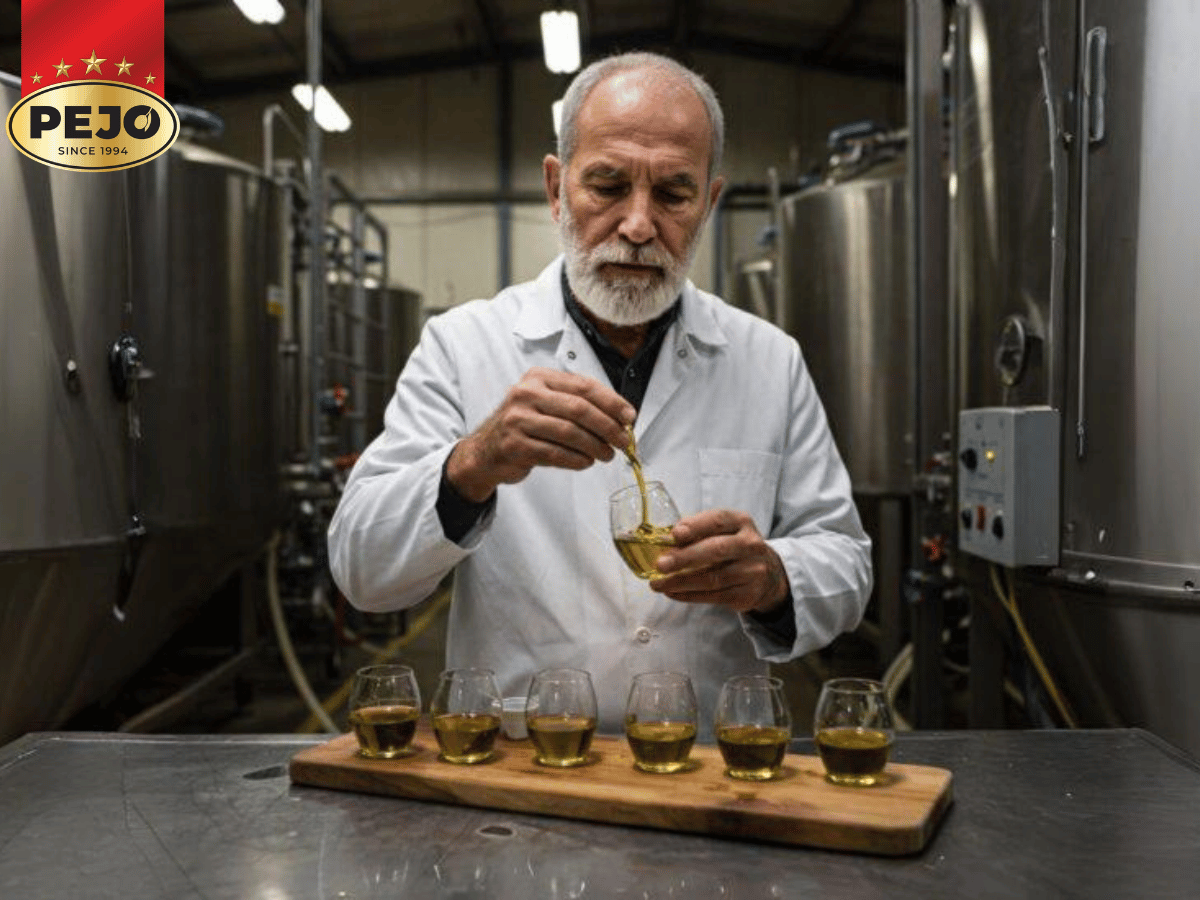
Laboratory testing is one of the most important aspects of olive oil supplier evaluation.
Product appearance and taste alone cannot establish whether an olive oil meets the requirements of its declared category. Chemical analysis and, where applicable, standardized sensory assessment are necessary components of quality verification.
Important Olive Oil Quality Parameters
Professional buyers should understand the main tests used to evaluate olive oil quality and authenticity.
| Quality parameter | What it helps evaluate |
|---|---|
| Free fatty acidity (FFA) | Hydrolytic degradation and classification requirements |
| Peroxide value | Primary oxidation |
| UV absorbance (K232, K270 and ΔK) | Oxidation and other characteristics relevant to classification and purity |
| Moisture and volatile matter | Water content and related quality considerations |
| Gas chromatography | Fatty acid composition and other selected authenticity parameters |
| Organoleptic assessment | Sensory characteristics and potential defects |
| Density and physical parameters | Physical product characteristics |
| Batch traceability | Identification and tracking throughout the supply chain |
The specific tests and acceptance limits depend on the olive oil category, destination market, and agreed product specification.
For products intended for the European market, buyers should consult the European Commission’s olive oil marketing standards, including the applicable chemical and sensory classification requirements.
International buyers should also consider the trade standards developed by the International Olive Council, alongside the legislation applicable in their destination country.
Request a Certificate of Analysis
A Certificate of Analysis, commonly referred to as a CoA, provides documented test results for a particular product or batch.
A useful CoA should identify the product, batch number, applicable specifications, analytical results, testing date, and the organization responsible for the analysis.
Buyers should establish whether testing is performed internally, by external laboratories, or through a combination of both.
For critical authenticity or regulatory parameters, independent testing by a suitably accredited laboratory may provide an additional level of assurance.
Verify Batch Traceability
A reliable olive oil supplier should maintain records that allow products to be traced throughout the relevant stages of sourcing, storage, processing, packaging, and distribution.
Effective traceability helps manufacturers investigate complaints, identify affected batches, and respond appropriately when quality or food safety issues arise.
Buyers should ask how the supplier connects incoming raw materials to storage tanks, production records, finished-product batch codes, and shipment documentation.
The European Commission’s general food law requirements provide further information about traceability obligations within the European food supply chain.
At PEJO, every incoming olive oil batch undergoes quality evaluation before entering the production process. Our laboratory procedures include chemical, physical, and sensory assessments, together with batch traceability verification.
5. Review Storage and Packaging Capabilities
Olive oil quality depends not only on sourcing and production but also on how the oil is stored, handled, and packaged.
Exposure to oxygen, excessive heat, and light can contribute to oxidation and the gradual deterioration of product characteristics.
For this reason, bulk olive oil procurement requires careful evaluation of the supplier’s storage infrastructure.
Controlled Olive Oil Storage
Professional olive oil storage facilities should have appropriate food-grade tanks, contamination prevention procedures, batch identification systems, and controls designed to protect the oil during storage.
Nitrogen protection is one technology used to reduce oxygen exposure within storage tanks.
By replacing oxygen-rich air in the tank headspace with nitrogen, manufacturers can help limit oxidation and preserve the oil’s characteristics before packaging.
At PEJO, our olive oils are stored in stainless-steel tanks under controlled conditions, supported by nitrogen protection technology.
Our facility has a bulk oil storage capacity of 500 metric tons, providing infrastructure for managing substantial quantities of olive oil before packaging.
Packaging Options for Retail and Food Service
A reliable olive oil supplier should offer packaging solutions appropriate to the buyer’s target market, product positioning, and distribution requirements.
Common packaging formats include:
| Packaging type | Typical commercial application |
|---|---|
| Dark glass bottles | Premium retail and extra virgin olive oil |
| Clear glass bottles | Selected retail and specialty products |
| PET bottles | Everyday retail and larger household formats |
| Metal tins | Family-sized products and food service |
| Bulk packaging | Industrial and wholesale procurement, where available |
Packaging evaluation should also include food-contact compliance, closure integrity, label durability, transport resistance, and product protection.
The right packaging decision balances consumer preferences, shelf presentation, logistics costs, product preservation, and applicable regulatory requirements.
Private Label Packaging and Product Development
For retailers and distributors developing their own brands, packaging flexibility is particularly important.
An experienced private label olive oil manufacturer can help align product category, bottle format, label presentation, packaging materials, and production requirements with the buyer’s commercial strategy.
At PEJO, we provide customized solutions covering oil selection and final packaging for retailers, distributors, international brands, and the HoReCa sector.
Our packaging portfolio includes different glass bottle designs, PET formats, and metal tins.
Learn more about our private label olive oil manufacturing solutions.
6. Assess Production Capacity and Supply Reliability
Reliable supply is essential for maintaining product availability, especially when working with supermarket chains, national distributors, and businesses that require regular replenishment.
A manufacturer may produce excellent olive oil but still be unsuitable for a buyer if it cannot consistently meet the required order volumes and delivery schedules.
Evaluate Actual Manufacturing Capacity
When comparing suppliers, request information about:
- Installed filling capacity.
- Actual output for the requested packaging format.
- Minimum order quantities.
- Standard and peak-season lead times.
- Available bulk storage.
- Production scheduling.
- Ability to accommodate increases in demand.
- Contingency arrangements for equipment or raw material disruptions.
Installed capacity should not be confused with guaranteed available production capacity. Actual output depends on bottle sizes, packaging requirements, changeovers, maintenance, staffing, and existing customer commitments.
Consider Seasonal Supply Risks
Olive oil is an agricultural product, and its availability can be influenced by harvest conditions, weather patterns, agricultural yields, and international market demand.
Professional procurement teams should assess how suppliers manage these fluctuations.
Important considerations include diversified sourcing, inventory planning, agreed product specifications, purchasing forecasts, and transparent communication regarding potential supply disruptions.
Any proposed changes to sourcing or product composition should remain consistent with contractual specifications and applicable labeling requirements.
PEJO Manufacturing Capacity
Our manufacturing infrastructure is designed to support domestic and international commercial requirements.
| Manufacturing indicator | PEJO capacity |
|---|---|
| Bulk oil storage | 500 metric tons |
| Combined filling capacity | Over 10,000 litres per hour |
| Automated filling lines | 3 |
| Production area | 4,000 m² |
| Business experience | Over 30 years |
| International export markets | Over 20 |
| Private labels | Over 10 |
These capabilities provide a foundation for supporting retail distribution, recurring orders, private label projects, and larger commercial requirements.
Order-specific production capacity, lead times, and delivery commitments are established during the quotation and planning process.
7. Evaluate International Distribution and Export Experience
When sourcing olive oil internationally, manufacturing quality is only one part of the procurement process.
The supplier must also understand international distribution, shipment preparation, documentation, and the requirements of different destination markets.
International Market Compliance
Food labeling, packaging, import procedures, and product classification requirements may differ between countries.
An experienced international olive oil supplier should be able to coordinate with buyers to establish the relevant requirements before production begins.
For businesses importing olive oil into the United States, the FDA’s Foreign Supplier Verification Programs (FSVP) explain applicable importer verification responsibilities.
For European markets, buyers must consider the relevant food safety, labeling, traceability, and olive oil marketing standards.
Logistics and Commercial Documentation
Depending on the shipment and destination, buyers may need documentation such as commercial invoices, packing lists, transport documents, certificates of origin, product specifications, and relevant analytical or compliance records.
International supply agreements should also establish responsibilities for transportation, insurance, customs clearance, and delivery.
The International Chamber of Commerce’s Incoterms® 2020 rules provide an internationally recognized framework for allocating relevant delivery responsibilities, costs, and transport risks between buyers and sellers.
PEJO has established international distribution relationships across more than 20 export markets, including the Balkans, Italy, the United Kingdom, the United States, and Canada.
Our experience supports market-specific product development, packaging adaptation, and international commercial partnerships.
Discover our global presence and international distribution network.
8. Compare Pricing Beyond the Cost per Litre
The lowest quotation is not necessarily the most economical procurement decision.
Professional buyers should assess the total landed cost of olive oil, including product pricing, packaging, labeling, transportation, insurance, customs duties, handling, and any additional compliance requirements.
Quality inconsistencies, damaged packaging, delayed deliveries, and rejected products may also create substantial indirect costs.
When comparing supplier quotations, ensure that each offer is based on the same olive oil category, quality specification, packaging format, order volume, and delivery terms.
This allows your purchasing team to make a meaningful comparison rather than evaluating prices in isolation.
A reliable commercial partnership should provide transparent pricing and a clear understanding of how future price adjustments will be managed.
9. Use an Olive Oil Supplier Evaluation Checklist
Before approving a new manufacturer, purchasing teams should conduct a structured supplier evaluation.
The following checklist can help businesses compare potential olive oil suppliers.
| Evaluation criterion | Evidence to request |
|---|---|
| Food safety certifications | Current certificates and certified scope |
| Product quality | Technical specifications and batch analysis |
| Olive oil authenticity | Relevant analytical testing and sourcing records |
| Batch traceability | Traceability procedures and sample records |
| Manufacturing infrastructure | Facility information and production capabilities |
| Storage conditions | Tank capacity and storage procedures |
| Supply reliability | Lead times and available production capacity |
| Packaging flexibility | Packaging catalogue and product samples |
| Private label capabilities | Customization options and project requirements |
| Export experience | Relevant market experience and shipment procedures |
| Commercial transparency | Detailed quotation and payment terms |
| Complaint management | Written procedures and corrective actions |
For larger procurement projects, consider requesting a facility visit, supplier audit, representative samples, or an initial trial order before entering a long-term agreement.
10. Questions to Ask Before Signing an Olive Oil Supplier Agreement
A reliable manufacturer should be able to provide clear answers to technical, operational, and commercial questions.
Product and Quality
- What quality standards does each olive oil category meet?
- Can you provide batch-specific Certificates of Analysis?
- How do you verify authenticity and manage traceability?
- What shelf life can you support for the selected product and packaging?
Production and Supply
- What production capacity is available for our order?
- What are your minimum order quantities and lead times?
- How do you manage seasonal supply fluctuations?
- Can you accommodate increases in demand?
Packaging and Private Label
- Which bottle sizes and packaging formats are available?
- Can you develop products under our own brand?
- Who is responsible for artwork approval and label compliance?
Commercial and Export Terms
- Which destination markets do you currently serve?
- What delivery terms and documentation can you provide?
- How are price changes, delays, complaints, and rejected batches managed?
The answers should form the basis of a written supplier agreement covering product specifications, delivery commitments, acceptance criteria, payment terms, and responsibilities.
Why Choose PEJO as Your Olive Oil Supply Partner?
At PEJO, we combine over three decades of family business experience with modern olive oil manufacturing, laboratory quality control, and international distribution.
Our portfolio includes extra virgin olive oil, virgin olive oil, olive pomace oil, blended products, and customized private label solutions.
With 500 metric tons of bulk storage capacity, three automated filling lines, and combined filling capacity exceeding 10,000 litres per hour, our manufacturing infrastructure supports a wide range of commercial requirements.
Our approach focuses on consistent product quality, transparent cooperation, controlled storage, packaging flexibility, and long-term business relationships.
Whether you are developing a retail olive oil collection, expanding your wholesale portfolio, sourcing products for food service, or launching your own private label, our team can help identify suitable solutions for your market.
Frequently Asked Questions
What should I look for in an olive oil supplier?
Evaluate the supplier’s food safety certifications, product specifications, laboratory testing, batch traceability, manufacturing capabilities, storage conditions, packaging options, and delivery reliability. These factors should be assessed alongside pricing and commercial terms.
What certifications should an olive oil supplier have?
Relevant certifications may include IFS Food, BRCGS Food Safety, and ISO 22000. Additional certifications, such as Kosher or Halal, may be important depending on your target market and customer requirements.
How can I verify the quality of bulk olive oil?
Request batch-specific Certificates of Analysis, detailed product specifications, representative samples, and traceability documentation. Independent laboratory testing can provide additional assurance where necessary.
Can olive oil manufacturers produce products under my own brand?
Yes. Manufacturers offering private label services can develop and package olive oil products under a customer’s brand. Available customization options typically depend on the product category, packaging format, order quantity, and market requirements.
What is the minimum order quantity for wholesale olive oil?
Minimum order quantities vary depending on the manufacturer, product category, packaging requirements, and whether the products are supplied under an existing brand or a private label. Buyers should request an order-specific quotation.
Can PEJO supply olive oil internationally?
PEJO serves more than 20 international export markets and provides olive oil products and private label solutions for different commercial requirements. Destination-specific availability, documentation, and delivery arrangements can be discussed with our team.
Find the Right Olive Oil Supplier for Your Business
Choosing a reliable olive oil supplier requires more than comparing prices. A successful procurement partnership depends on verified product quality, food safety, manufacturing capabilities, transparent communication, and dependable supply.
At PEJO, we understand the importance of these factors for retailers, distributors, importers, and private label businesses.
If you are looking for an olive oil manufacturing partner, we invite you to discuss your product specifications, purchasing volumes, packaging preferences, and distribution requirements with our team.