Starting your own olive oil brand can be an attractive business opportunity for entrepreneurs, retailers, food distributors, and companies looking to expand their product portfolios. However, creating a successful brand requires more than selecting an olive oil and designing an attractive bottle.
Product quality, packaging, market positioning, regulatory compliance, manufacturing capabilities, and supply reliability all play important roles in developing a sustainable olive oil business.
If you are researching how to start an olive oil brand, private label manufacturing offers a practical route to market without the need to establish your own production and bottling facility.
By working with an experienced manufacturing partner, you can develop olive oil products under your own brand while relying on established infrastructure for oil selection, quality control, filling, and packaging.
This guide explains the essential steps involved in creating your own olive oil brand, from the initial business concept to the finished product.
What Is a Private Label Olive Oil Business?
Private label olive oil is a product manufactured or packaged by a third-party company and marketed under another business’s brand.
Instead of investing in olive oil processing equipment, storage facilities, laboratory infrastructure, and bottling lines, the brand owner works with a manufacturing partner that provides the necessary production services.
Depending on the agreement, the manufacturer may support several stages of product development, including oil selection, packaging customization, filling, labelling, and preparation for distribution.
The brand owner generally focuses on commercial strategy, brand identity, sales, marketing, and customer relationships.
This business model is particularly suitable for:
- Entrepreneurs launching new food brands.
- Supermarket chains developing their own product ranges.
- Food distributors expanding their portfolios.
- Gourmet and specialty food retailers.
- Restaurants and hospitality businesses.
- E-commerce companies selling premium food products.
- Importers targeting specific international markets.
Explore PEJO’s private label olive oil manufacturing solutions to understand how customized products can be developed for different business requirements.
1. Identify Your Target Market
Before selecting a bottle or designing your label, establish who your customers will be and what they expect from an olive oil product.
A premium extra virgin olive oil intended for specialty stores requires a different strategy from an affordable cooking oil designed for supermarket distribution.
Choose Your Market Positioning
Your brand should have a clear commercial identity that reflects the needs of your target audience.
| Market segment | Potential product strategy |
|---|---|
| Premium retail | Extra virgin olive oil in elegant glass bottles |
| Supermarket distribution | Accessible products with competitive pricing |
| Gourmet food stores | Distinctive oils and specialty flavours |
| Restaurants and HoReCa | Practical packaging and larger capacities |
| E-commerce | Attractive packaging and differentiated products |
| Wholesale distribution | Consistent quality and economical formats |
| Corporate gifting | Premium presentation and customized packaging |
Research competing products within your intended market. Evaluate their pricing, packaging sizes, product descriptions, shelf positioning, and customer reviews.
Understanding these factors can help you identify opportunities for differentiation rather than launching another generic olive oil product.
Establish Your Unique Selling Proposition
A strong olive oil brand should give consumers a clear reason to choose its products.
Your positioning might focus on Mediterranean culinary heritage, verified geographical origin, premium packaging, everyday affordability, distinctive flavour characteristics, or convenience.
However, claims relating to origin, quality, organic production, sustainability, or nutritional benefits must be supported by appropriate documentation and applicable regulatory requirements.
Authentic, verifiable product characteristics provide a stronger foundation for long-term brand development than unsupported marketing claims.
2. Choose Your Olive Oil Category
Selecting the right oil is one of the most important decisions when starting an olive oil business.
Different categories have distinct production methods, sensory characteristics, commercial applications, and regulatory requirements.
Extra Virgin Olive Oil
Extra virgin olive oil is the highest recognized grade of virgin olive oil. It must satisfy specific chemical and sensory requirements, including a maximum free acidity of 0.8%.
It is particularly suitable for premium retail products, gourmet brands, specialty food collections, and consumers who value natural olive flavour.
Virgin Olive Oil
Virgin olive oil is also obtained directly from olives through permitted mechanical or physical extraction methods.
Its classification requirements differ from those of extra virgin olive oil, making it another option for businesses developing everyday cooking products.
Olive Pomace Oil
Olive pomace oil is produced from material remaining after the initial extraction of olive oil. The recovered oil undergoes refining and is blended with edible virgin olive oils to create the commercial product.
It is commonly selected for food service, frequent frying, and cost-conscious cooking applications.
Blended and Flavoured Oil Products
Blended oil products can be developed to meet particular commercial and culinary requirements, depending on their composition.
Flavoured olive oil products offer additional opportunities for gourmet retail, gift collections, and differentiated product lines.
Common flavours include garlic, chilli, basil, and truffle.
Before selecting your product category, read our guide to the differences between extra virgin, virgin, and pomace olive oil.
The European Commission’s official olive oil classifications also provide useful information about the characteristics and regulatory definitions of different olive oil categories.
3. Find a Reliable Private Label Olive Oil Manufacturer
Your manufacturing partner will influence the quality, availability, consistency, and commercial performance of your finished products.
Choosing a supplier based solely on the lowest price can expose your business to quality problems, production delays, packaging inconsistencies, and supply interruptions.
A reliable private label olive oil manufacturer should demonstrate established production capabilities, transparent quality procedures, and the ability to accommodate your commercial requirements.
What Should You Look for in a Manufacturing Partner?
| Evaluation factor | What to verify |
|---|---|
| Product range | Available oil categories and specifications |
| Production capacity | Filling infrastructure and available output |
| Food safety | Applicable certifications and audit scope |
| Quality control | Laboratory analysis and product inspection |
| Traceability | Raw material and finished-product identification |
| Packaging | Available bottles, closures, tins, and labels |
| Customization | Private label development capabilities |
| Logistics | Shipment preparation and export experience |
| Commercial terms | Minimum orders, pricing, and lead times |
Request product samples, technical specifications, and relevant certification documentation before committing to a manufacturer.
For larger projects, a facility visit or supplier audit may provide additional assurance.
Our detailed guide on how to choose a reliable olive oil supplier explains the supplier evaluation process in greater detail.
Manufacturing Your Olive Oil Brand with PEJO
At PEJO, our manufacturing infrastructure supports olive oil production, packaging, and private label development for domestic and international businesses.
Our facilities include a 4,000-square-metre production area, three fully automated filling lines, 500 metric tons of bulk oil storage capacity, and combined filling capacity exceeding 10,000 litres per hour.
These capabilities provide a foundation for supporting different packaging formats and commercial order requirements.
Discover our olive oil production and bottling capabilities to learn more about our manufacturing operations.
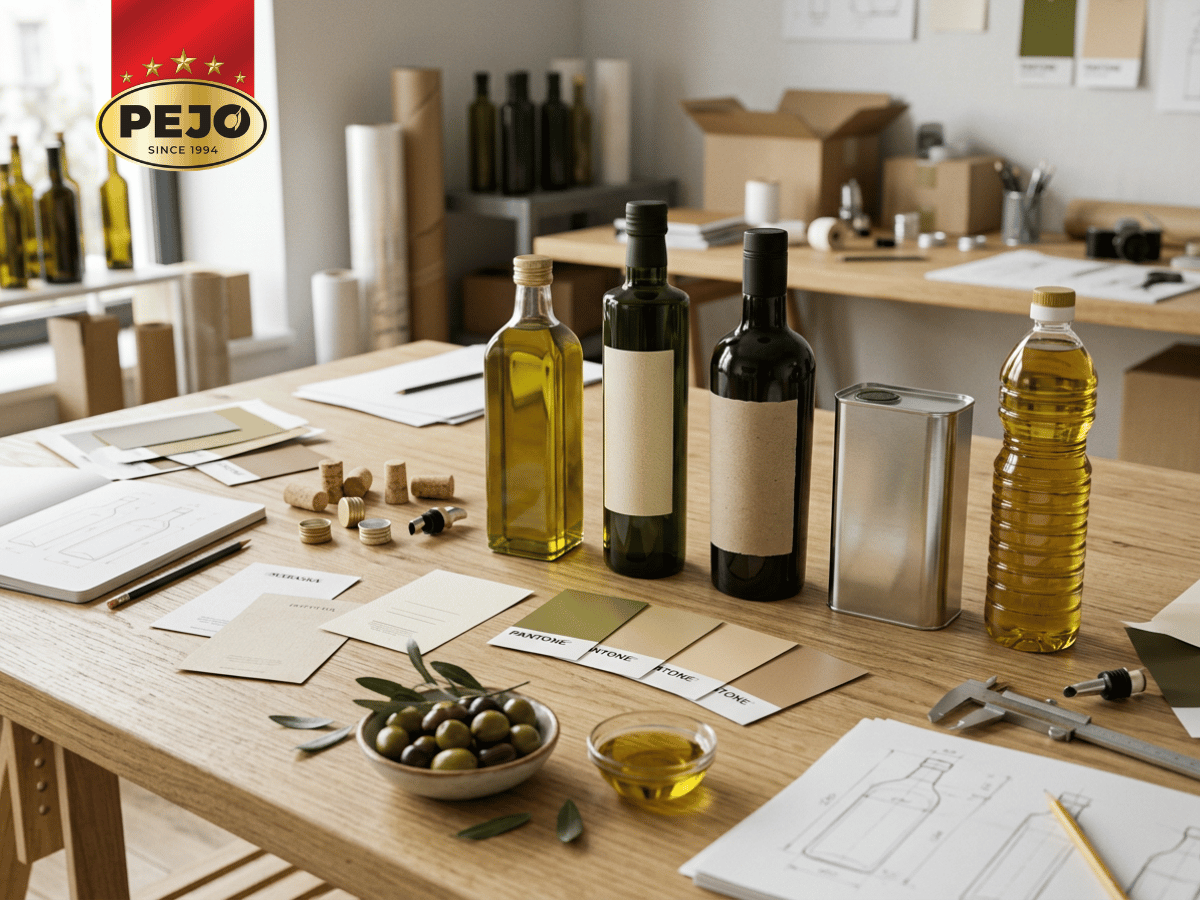
4. Choose Your Bottle Sizes and Packaging
Packaging is one of the most visible elements of an olive oil brand.
It affects consumer perception, product protection, shelf presentation, transportation costs, and the overall commercial positioning of your products.
An attractive bottle may help differentiate your brand, but packaging must also be practical, compliant, and suitable for the intended distribution channel.
Glass Bottles
Glass bottles are widely used for premium and retail olive oil products.
Dark glass can help reduce light exposure, while different bottle shapes allow businesses to establish a distinctive visual identity.
Common designs include Maraska, Dorica, Quadra, Puglia, and other traditional or contemporary bottle shapes.
Glass packaging is especially relevant for gourmet products, premium extra virgin olive oil, and specialty retail collections.
PET Bottles
PET bottles offer a lightweight packaging alternative commonly used for everyday retail and larger household formats.
Their lower weight can be advantageous when managing transport costs and handling larger product volumes.
PET packaging may be particularly suitable for value-oriented brands, supermarket distribution, and practical cooking oil products.
Metal Tins
Metal tins provide protection against light and are commonly used for larger olive oil capacities.
They can be suitable for family-sized products, food service businesses, restaurants, and premium Mediterranean-inspired packaging concepts.
Available Olive Oil Packaging Formats
| Packaging material | Typical available capacities |
|---|---|
| Glass bottles | 250 ml, 500 ml, 750 ml and 1 L |
| PET bottles | 250 ml, 500 ml, 1 L, 1.5 L, 3 L and 5 L |
| Metal tins | 3 L and 5 L |
These formats are represented in PEJO’s packaging portfolio. Availability depends on the selected bottle design, oil category, production configuration, and project requirements.
When developing a private label olive oil brand, consider beginning with a focused selection of bottle sizes rather than launching too many product variations simultaneously.
A smaller initial product range can simplify inventory management, packaging procurement, and market testing.
5. Develop Your Olive Oil Brand Identity
Brand identity determines how consumers recognize, understand, and remember your products.
A successful olive oil brand should maintain a consistent visual and commercial identity across its packaging, website, product photography, marketing materials, and retail presentation.
Choose a Distinctive Brand Name
Your brand name should be memorable, appropriate for your target market, and suitable for the product positioning you have selected.
Before investing in packaging design, investigate whether the name is already registered or used by another business in the relevant product category and territory.
The World Intellectual Property Organization’s Global Brand Database provides a useful starting point for trademark research.
Additional checks through national or regional trademark offices may be necessary before registering and using your brand.
Create a Consistent Visual Identity
Your olive oil packaging should communicate the product’s characteristics and intended market position.
Important design elements include:
- Brand name and logo.
- Colour palette and typography.
- Bottle shape and closure design.
- Front and back label layout.
- Product category and essential information.
- Visual differentiation between product variants.
- Outer carton and secondary packaging design.
Premium brands may benefit from understated typography, elegant glass packaging, and refined visual details. Everyday retail brands may prioritize clear product identification, recognizable colours, and accessible messaging.
Develop a Brand Story
A meaningful brand story can help establish an emotional connection with consumers.
Your story might reflect Mediterranean food culture, culinary traditions, family values, a particular verified geographical origin, or a commitment to consistent product quality.
The most effective brand stories are connected to genuine product characteristics and business values.
Avoid presenting fictional agricultural origins or implying that your company owns olive groves or production facilities when it does not.
6. Understand Olive Oil Labelling and Regulatory Requirements
Food labelling is an essential part of developing your own olive oil brand.
Unlike general product packaging, olive oil labels must communicate specific information required by the legislation applicable in the intended market.
Requirements may differ between the European Union, United Kingdom, United States, Canada, and other destinations.
What Information Should an Olive Oil Label Include?
Depending on the product category and destination market, olive oil packaging may need to include information such as:
- The legal product designation.
- Net quantity.
- Best-before information.
- Batch or lot identification.
- Storage instructions.
- Responsible food business operator information.
- Nutritional information.
- Ingredient information, where required.
- Geographical origin information, where required.
- Applicable category-specific declarations.
Certain single-ingredient products may qualify for exemptions from specific declarations. The exact requirements must be evaluated for each product and market.
European Union Olive Oil Labelling
Businesses targeting EU consumers should review Commission Delegated Regulation (EU) 2022/2104, together with its applicable amendments and consolidated version.
The regulation establishes olive oil marketing requirements covering product categories, origin declarations, packaging, and certain voluntary labelling statements.
General food information requirements are addressed under Regulation (EU) No 1169/2011.
Extra virgin and virgin olive oil sold in the EU are subject to specific origin labelling requirements. The location where the oil is packaged does not necessarily establish the geographical origin of the olives or oil.
Labelling Olive Oil for the United States
Businesses planning to sell olive oil in the United States should review the applicable federal and state requirements.
The FDA’s guide to starting a food business provides information about food labelling, manufacturing, and other regulatory considerations.
Importers may also have additional responsibilities relating to foreign supplier verification and food safety compliance.
Before approving final artwork, establish who is responsible for verifying label compliance and maintaining the relevant technical documentation.
7. Understand Minimum Order Quantities and Startup Costs
One of the most common questions when starting an olive oil brand concerns the initial investment.
There is no universal minimum order quantity or fixed startup cost for private label olive oil.
Commercial requirements depend on the selected oil, packaging format, customization level, destination market, production configuration, and total order volume.
What Determines the Minimum Order Quantity?
Manufacturers establish minimum order quantities based on several operational considerations, including:
- Bottle and closure procurement.
- Customized label printing.
- Production line preparation and changeovers.
- Oil category and required quantities.
- Secondary packaging requirements.
- Manufacturing and logistics efficiency.
Using standard bottle designs with customized labels may offer a simpler entry point than commissioning entirely bespoke packaging components.
Main Olive Oil Brand Startup Costs
| Cost category | Description |
|---|---|
| Olive oil | Selected oil category and product specification |
| Primary packaging | Bottles, caps, closures, or metal tins |
| Label development | Artwork, design, printing, and finishes |
| Manufacturing | Filling, sealing, labelling, and packaging |
| Compliance | Product testing and regulatory review where required |
| Trademark | Brand registration and intellectual property protection |
| Logistics | Transport, warehousing, insurance, and import costs |
| Marketing | Website, photography, advertising, and retail promotion |
Request a detailed quotation based on your anticipated order quantities and packaging requirements.
When comparing manufacturers, evaluate the total commercial cost rather than focusing exclusively on the price per litre.
8. Request Product Samples and Verify Quality Assurance
Before approving a commercial production order, evaluate representative samples of your proposed olive oil products.
Sampling allows you to assess product characteristics, packaging presentation, and suitability for your intended market.
What Should You Evaluate During Sampling?
Assess the oil’s flavour, aroma, declared category, and relevant technical specifications.
Review bottle appearance, closure performance, label quality, fill presentation, and outer packaging.
For products targeting premium markets, sensory evaluation may be particularly important.
The approved sample and associated specifications should form part of the agreement between your company and the manufacturing partner.
Laboratory Testing and Batch Traceability
An experienced olive oil manufacturer should maintain quality procedures designed to evaluate incoming materials and finished products.
Depending on the category, relevant testing may include free fatty acidity, peroxide value, ultraviolet absorbance, fatty acid composition, and sensory assessment.
At PEJO, incoming olive oil batches undergo laboratory quality evaluation before entering production.
Our oils are stored in stainless-steel tanks under controlled conditions, supported by nitrogen protection technology to help minimize oxygen exposure before packaging.
Explore our approach to olive oil quality control, laboratory analysis, and food safety.
Review Manufacturer Certifications
Relevant food safety certifications can provide additional assurance when evaluating a private label manufacturing partner.
PEJO’s documented certification portfolio includes IFS Food, BRCGS Food Safety, ISO 22000, ISO 9001, ISO 14001, ISO 45001, Kosher, and Halal certifications.
Buyers should request the applicable certificates and confirm their current validity, certified scope, and relevance to the proposed products.
9. Learn from Existing Private Label Olive Oil Products
Reviewing existing private label products can help businesses understand how different oil categories, packaging formats, and visual identities can be adapted to particular market segments.
PEJO’s private label portfolio includes projects developed for different retail and distribution requirements.
Examples documented in our product portfolio include:
| Private label | Product development examples |
|---|---|
| Pema | Extra virgin, virgin, blended, and flavoured oil products |
| Berati | Extra virgin, virgin, and blended olive oils |
| Artizania | Extra virgin and flavoured olive oil products |
| Luma | Extra virgin, virgin, blended, and flavoured oils |
| Italiano | Extra virgin and olive pomace oil products |
| iBudget | Extra virgin and olive pomace oil products |
| oviOli | Extra virgin and olive pomace oil products |
These examples demonstrate how oil selection, packaging, and brand presentation can vary according to commercial objectives.
A private label project does not need to follow an existing brand’s design. Each project should be developed around the customer’s own identity, specifications, and target market.
Discover Italiano Olive Pomace Oil as an example of a private label product category within our wider portfolio.
10. Prepare to Launch Your Olive Oil Brand
Once your product specifications, packaging, artwork, quality requirements, and manufacturing arrangements have been approved, the next stage is commercial launch.
A well-planned launch should connect production readiness with distribution, sales, and marketing activities.
Establish Your Distribution Channels
Depending on your business model, your olive oil products may be sold through independent retailers, supermarkets, online stores, food distributors, restaurants, or direct wholesale relationships.
Each distribution channel has different requirements for pricing, order quantities, packaging, logistics, and promotional support.
Develop Your Marketing Materials
Prepare professional product photography, accurate product descriptions, technical information, promotional materials, and a brand website where appropriate.
Marketing content should remain consistent with the approved product specifications and label declarations.
Communicate genuine product benefits and culinary applications rather than relying on unsupported health or quality claims.
Plan Inventory and Replenishment
A successful launch requires sufficient inventory to meet initial demand while avoiding unnecessary stock accumulation.
Coordinate sales forecasts with your manufacturer and establish realistic replenishment schedules.
Consider shelf life, storage conditions, seasonal demand, transport lead times, and packaging availability when developing your inventory strategy.
Private Label Olive Oil Brand Launch Checklist
Before placing your first commercial order, confirm that the following stages have been completed.
| Development stage | Required outcome |
|---|---|
| Market research | Defined target customers and positioning |
| Product selection | Approved oil category and specifications |
| Manufacturer selection | Verified production and quality capabilities |
| Packaging | Approved bottle, closure, and carton formats |
| Brand identity | Final brand name and visual identity |
| Labelling | Market-specific compliance reviewed |
| Sampling | Representative product sample approved |
| Commercial agreement | Pricing, quantities, and lead times confirmed |
| Logistics | Delivery responsibilities established |
| Marketing | Product information and launch materials prepared |
Completing these stages before production can help reduce unexpected costs, delays, and packaging revisions.
Why Develop Your Own Olive Oil Brand with PEJO?
At PEJO, we combine more than three decades of business experience with modern manufacturing, packaging flexibility, laboratory quality control, and international distribution capabilities.
Our private label services are designed to support retailers, distributors, entrepreneurs, food service businesses, and international brands developing their own olive oil products.
Our infrastructure includes:
- 500 metric tons of bulk oil storage capacity.
- Three fully automated filling lines.
- Combined filling capacity exceeding 10,000 litres per hour.
- A 4,000-square-metre production area.
- Nitrogen-protected stainless-steel storage.
- Multiple glass, PET, and metal tin packaging options.
- Experience across more than 20 export markets.
- A portfolio of more than 10 private labels.
From oil selection to final packaging, our team works with businesses to develop solutions aligned with their commercial objectives, product specifications, and target markets.
Specific minimum order quantities, available production capacity, customization options, pricing, and delivery arrangements are established individually for each project.
Frequently Asked Questions
Can I start an olive oil brand without owning a factory?
Yes. Private label manufacturing allows businesses to develop and sell olive oil products under their own brand while outsourcing manufacturing, bottling, and packaging to an established supplier.
How much does it cost to start an olive oil brand?
The cost depends on the selected oil category, order quantity, packaging, branding, regulatory requirements, and distribution strategy. Requesting a project-specific quotation is the most reliable way to estimate the initial investment.
Can I choose my own olive oil bottle and label?
Private label manufacturers commonly offer different bottle formats and customized labelling options. Availability depends on the manufacturer’s packaging portfolio, production equipment, and minimum order requirements.
What is the minimum order quantity for private label olive oil?
Minimum order quantities vary according to the product category, packaging format, label requirements, and manufacturing process. PEJO evaluates these requirements individually for each project.
Can I sell my private label olive oil internationally?
Yes, provided your products meet the relevant food safety, labelling, import, and commercial requirements of each destination market.
Can PEJO manufacture olive oil products under my own brand?
PEJO offers customized private label solutions covering oil selection, packaging, and manufacturing requirements for retailers, distributors, international brands, and food service businesses.
Start Your Own Olive Oil Brand with PEJO
Building a successful olive oil brand requires careful planning, reliable manufacturing, consistent quality, distinctive packaging, and a clear understanding of your target market.
Working with an experienced private label manufacturer can simplify the development process and allow your business to concentrate on building its brand, distribution network, and customer relationships.
At PEJO, we provide customized olive oil manufacturing and packaging solutions designed around the needs of our commercial partners.
Whether you are launching your first olive oil product or expanding an established retail collection, our team can help you evaluate suitable oil categories, packaging formats, and production requirements.
Contact PEJO to discuss your private label olive oil project and request a personalized quotation.